
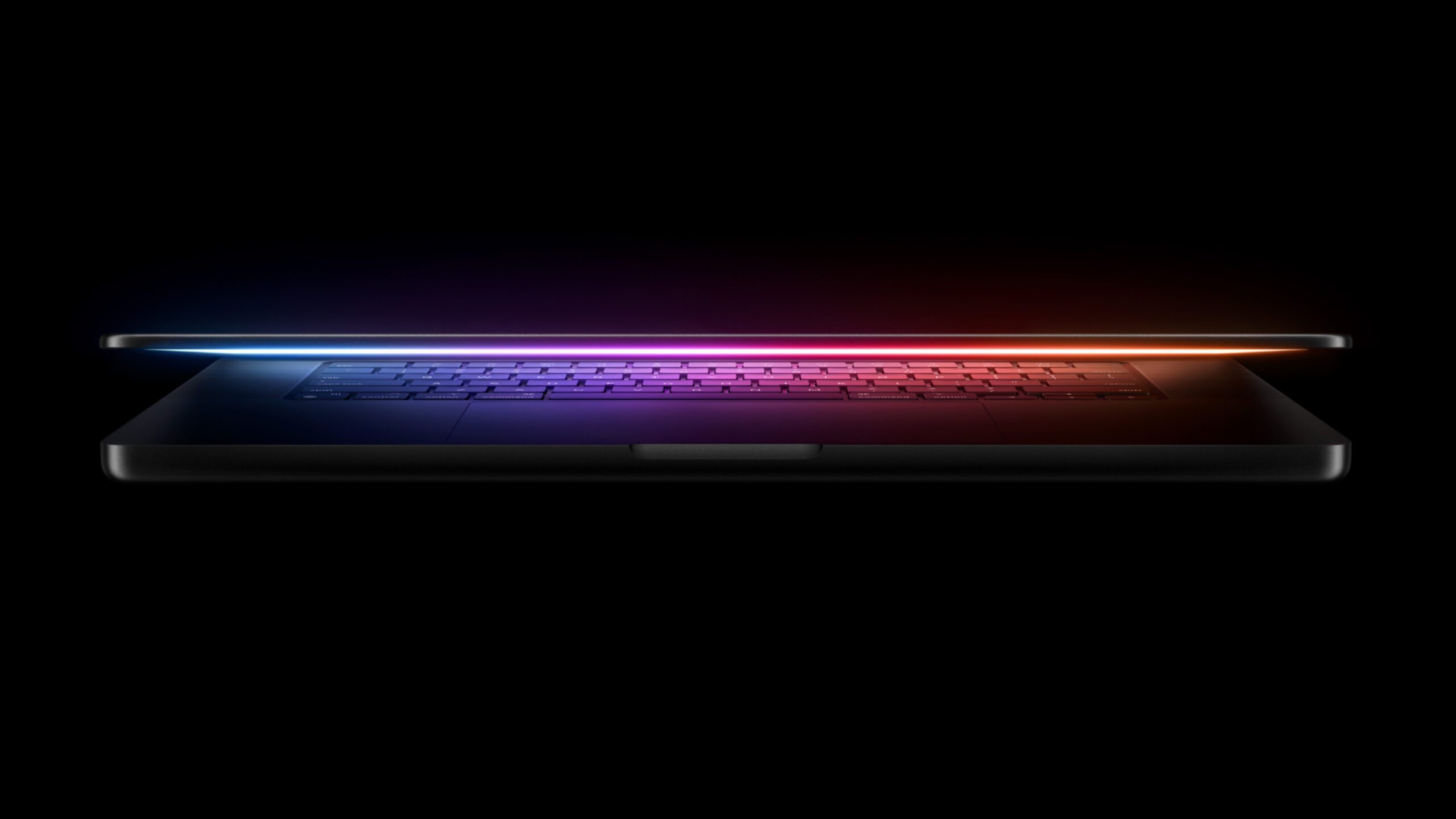
Saving the best for last, this is the product that many of us have all been truly waiting for. For twenty years, Apple has continued to improve upon its most advanced notebooks yet, bringing powerful performance and innovative features that allow pro customers to take their creativity to new heights. This Wednesday is likely the day that Apple will unveil the redesigned MacBook Pro. Here’s everything we can expect for Apple’s next high-end laptops:
Chip
The first thing that we should discuss is the performance. In March of this year, Apple updated its higher-end MacBook Pro with the M5 Pro and M5 Max chips, but this time, the new higher-end MacBook Pro models are expected to continue using both of those chips. Why? According to Mark Gurman from Bloomberg, he expects that Apple will just debut the standard M6 chip as the only chip in that generation. This means that Apple will skip both the M6 Pro and M6 Max chips to focus more on making substantial AI performance for the future M7 series of chips. This means that we will see the M7 Pro and the M7 Max chips as soon as late next year for the future MacBook Pro models.
Connectivity
Apple brought the N1 chip to the higher-end MacBook Pro models that were updated earlier this year. If you’re not familiar with that chip, it’s Apple’s custom-designed wireless networking chip that consolidates Wi-Fi 7, Bluetooth 6, and Thread, and it also improves the performance and reliability of peer-to-peer features such as AirDrop and AirPlay. It’s obvious that the new higher-end MacBook Pro will feature the same chip as the current models.
Now, one feature that Apple is bringing to a MacBook for the first time is cellular connectivity. I believe that the reason Apple waited so long to put it on its MacBooks is that Apple wanted to offer the most optimal performance and efficiency possible when connecting to cellular networks, and after several years of mastering its own in-house silicon, Apple is now ready to put its cellular modem in MacBooks, starting with these MacBook Pros. I’m willing to bet that the higher-end MacBook Pro will feature the latest C2 cellular modem that debuted on the iPhone 18 Pro, the iPhone Duo, and the new iPad mini that was announced today. Having cellular connectivity built right into the MacBook Pro means taking your workflow with you wherever you go while staying connected through emails and videoconferencing. You won’t have to worry about tethering through your iPhone’s personal hotspot and draining your iPhone’s battery in the process. Of course, cellular connectivity will be an optional upgrade on this MacBook Pro, similar to iPad models from the very beginning, so I’d expect this feature to be around a $200 upgrade since Apple charges you $200 to get cellular on the current iPad Pro.
Design & Display
The current design of the MacBook Pro righted all the wrongs in many ways by bringing back some of the legacy I/O such as an HDMI port and the SDXC card slot as well as bringing back the row of function keys. However, for some people, the MacBook Pro feels a bit heavy, especially for the larger 16-inch MacBook Pro, which weighs in at 4.7 pounds. Gurman reported that Apple could shave a little bit of weight off for its next higher-end MacBook Pros, so they would feel slightly lighter overall. The upcoming MacBook Pros could also get slightly thinner as well, so the design may not change as some may have hoped for.
However, one improvement that contributes to a thinner design is the massive upgrade to the display. As rumored for a long time, the higher-end MacBook Pro is expected to transition from mini-LED displays to tandem OLED displays. This is the same technology that’s on the current iPad Pro, where two OLED panels are stacked together for double the brightness levels and contrast ratios while maintaining the efficiency and overall longevity of those panels. The use of OLED displays will also allow Apple to have a camera cutout on those displays to make room for the Dynamic Island. This will be a great home for Siri AI to reside in since it can morph dynamically whenever you need to summon Siri AI. The displays on both the 14-inch and 16-inch could also get larger, with a 14.3-inch and a 16.3-inch, respectively, compared to the 14.2-inch and 16.2-inch.

Additionally, it has been rumored that Apple will bring direct touchscreen support to the Mac for the first time with these MacBook Pros. This has been controversial since Apple has long been known to object to putting touchscreens on Macs, and the reason is simple: touchscreens don’t want to be vertical, but rather, they want to be horizontal to give you the most ergonomic experience, as explained by Steve Jobs back in Apple’s “Back to the Mac” event on October 20, 2010. Plus, macOS is made to be a cursor-first interface. However, things may have changed with the iPad. From the very beginning, the iPad has always been made for a touch-first interface, but Apple eventually added mouse and trackpad support in iPadOS back in 2020. This means you can use either a mouse or trackpad as a secondary input for your iPad while using multi-touch as the main input.
So with the upcoming MacBook Pros, it appears that Apple continues to offer the best of both worlds by bringing multi-touch as secondary input for the Mac while using a mouse/trackpad as the primary input. Even the recent features in macOS 27 Golden Gate have given us big hints, especially the new gestures across several apps like “swipe to refresh”, and Apple even brought direct touch support in the Sidecar feature where you can use the iPad as an extended monitor for your Mac. Gurman even reported that Apple has been working on making macOS feel more optimized for touch by bringing several UI elements that would be easier to touch. Who knows? Apple could bring Apple Pencil support similar to how the iPhone Duo now supports Apple Pencil. This would be great for quick annotations and directly e-signing PDF files.
Pricing & Availability
Because of the breakthrough features coming to the next MacBook Pros like the tandem OLED display, rumors have indicated that these machines will be priced higher than the current mini-LED models. To put things in perspective, the 14-inch MacBook Pro with M5 Pro starts at $2499, and the 16-inch MacBook Pro with M5 Pro starts at $2999. Some are expecting around a $500 price increase at most; if Apple were to price these machines that high, starting at $2999 for the 14-inch model, Apple could continue to offer the current mini-LED models at the same prices. This would be similar to when Apple introduced the Retina MacBook Pro back in 2012, and since they started at a substantially higher price, Apple continued to offer the non-Retina Unibody MacBook Pros at the same price for a while until they eventually phased out the older design as prices for the newer design went down.
Recent rumors suggested that Apple will showcase the redesigned MacBook Pro in person at 10:00 a.m. PT at its “Pro and tell” Apple Experience in Los Angeles, CA, and pre-orders for everything Apple will announce this week will begin at 10:10 a.m. PT afterwards. Since the just-announced iPad mini will be available to customers on November 6, I’d expect that the OLED MacBook Pros will also be available on that day as well.
Conclusion
All in all, this is certainly one of the most exciting products to look forward to this year, and Apple will certainly go out with a bang by wrapping up its year of product announcements with these redesigned MacBook Pros. Make sure you bookmark this site and follow our socials so you can stay up to date with the latest news and deals about Apple.
Comments
Comments will load as you approach this section.